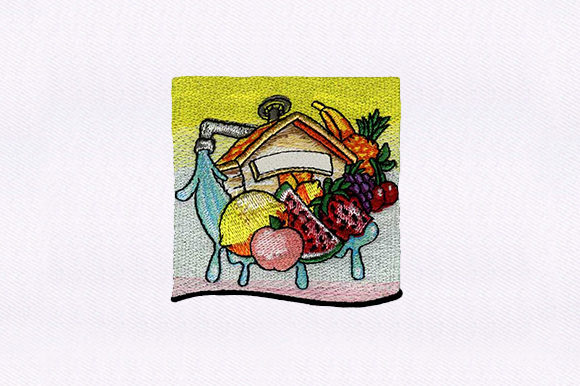
Fruits House Embroidery Review for Small Business Merch
As an embroidery designer who has spent years digitizing logos and reviewing files for commercial use, I approach every new machine embroidery design with a critical eye. It is not just about whether a pattern looks cute on a screen; it is about how that digital embroidery file translates into a tangible asset for a brand. Today, I am reviewing Fruits House, a design positioned within the Food category, to determine its viability for small business merch, branded patches, and custom apparel.
The first impression of Fruits House is one of approachable charm. Based on the title and the promise of a "lovely embroidery," this design leans heavily into a friendly, rustic, and handmade aesthetic. For businesses in the food sector—such as local bakeries, farm-to-table cafés, organic juice bars, or artisanal grocery stores—this visual personality is gold. It avoids the cold, corporate feel of modern minimalism in favor of something that suggests warmth, freshness, and community. When a customer sees this stitched onto an apron or a tote bag, the immediate psychological association is with quality ingredients and human care.
Real-World Application for Brand Identity
The true test of any embroidery file is its versatility in a commercial setting. Fruits House shines when applied to items that serve as walking billboards for a brand. Imagine a boutique coffee shop looking to upgrade their staff uniforms. Stitching this design onto the chest pocket of a work shirt or the front of a canvas apron embroidery project instantly elevates the team's appearance from generic service workers to brand ambassadors. The design acts as a seal of authenticity.
Beyond uniforms, this design is exceptionally well-suited for embroided patch production. Patches are a trending element in small business merch because they offer flexibility. A bakery could produce a run of Fruits House patches to sell as add-ons at the counter, allowing customers to customize their own jackets or bags. Alternatively, these patches can be sewn onto tote bag design projects, creating durable, reusable shopping bags that customers actually want to carry around town. This increases brand identity visibility far beyond the storefront.
For cap embroidery, the design offers a playful accent. Whether placed on the front panel of a dad hat or as a side detail on a trucker cap, the fruity theme aligns perfectly with summer promotions or outdoor market stalls. The key here is consistency. Using Fruits House across various design assets—from employee apparel to customer gifts—creates a cohesive visual language that builds trust and recognition.
Navigating Technical Challenges in Production
While the aesthetic appeal is high, a professional review must address the technical realities of stitching. The description notes that the design will look great on "any fabric," but experienced decorators know that fabric texture plays a massive role in the finished product. On smooth, tightly woven cotton or poly-cotton blends, Fruits House will likely render with crisp edges and vibrant thread colors. However, caution is advised when applying this to textured fabrics like heavy wool, terry cloth, or loose-weave linens.
If the design features fine details or small lettering inherent to the "House" concept, these elements may get lost or become muddy on rougher surfaces. Furthermore, when scaling the design down for small applications, such as a sleeve detail or a tiny label, one must be wary of stitch density. High-density stitching on small areas can lead to puckering, especially if the proper stabilizer is not used. Before running a full production batch, it is crucial to test the file on the exact material intended for the final product.
Curved surfaces present another challenge. If you plan to use Fruits House for cap embroidery, ensure the digitizing accounts for the curvature of the front panel. Designs that look flat on a screen can distort when stitched onto a curved surface if the pull compensation isn't adjusted correctly. Similarly, dark uniforms require careful consideration of thread contrast. While the design is described as lovely, ensure the selected thread palette pops against navy, black, or charcoal backgrounds to maintain readability and visual impact.
Enhancing Customer Trust and Product Value
In the era of mass-produced goods, handmade touches carry significant weight. Utilizing Fruits House signals to your customers that you value quality and detail. For Etsy sellers and crafters, incorporating this machine embroidery design into product listings can increase perceived value. A simple tote bag becomes a premium accessory; a plain apron becomes a chef's essential tool. This elevation in perceived quality directly influences buyer engagement and can justify higher price points.
Moreover, consistent use of branded embroidery fosters loyalty. When a regular customer sees their favorite café owner wearing an apron with the Fruits House logo, it reinforces the personal connection between the business and the community. It transforms a transaction into a relationship. For event merch, such as local food festivals or farmers' markets, having embroidered items available creates a sense of exclusivity and professionalism that printed vinyl simply cannot match.
Practical Notes for the Professional Decorator
Before committing to a large run of commercial embroidery using Fruits House, I recommend a rigorous testing protocol. First, stitch the design in black and white or a monochromatic scheme. This reveals the underlying structure of the stitch pattern without the distraction of color, helping you identify potential density issues or gaps in coverage.
- Check Scalability: Verify that the design remains legible at the smallest intended size, particularly for patch applications.
- Review Thread Contrast: Ensure your chosen thread colors provide sufficient contrast against the base fabric, especially for dark uniforms.
- Inspect Spacing: Look closely at the spacing between elements to prevent thread breaks or bird-nesting during high-speed machine runs.
- Confirm Hoop Size: Although specific dimensions are not provided in the description, always measure your hoop against the design file to ensure it fits without requiring re-hooping, which can cause alignment errors.
- Test on Real Fabric: Never rely solely on a digital simulation. Stitch a sample on the actual fabric weight and type you plan to use.
- Use Proper Stabilizer: Match your stabilizer to the fabric stretch and weight to prevent distortion and ensure a clean backside.
- Create a Mockup: Generate a printable mockup or a physical sample for client approval before finalizing the order.
- Verify Licensing: Since this is for business use, confirm the commercial licensing terms included with the digital embroidery file to ensure you are compliant for selling merchandise.
In conclusion, Fruits House represents a strong candidate for businesses looking to inject personality and professionalism into their branding. Its alignment with the Food category makes it a natural fit for culinary brands, but its charming aesthetic allows it to transcend into lifestyle and retail sectors as well. By paying attention to technical details like hoop size, stabilizer selection, and fabric compatibility, embroidery professionals can leverage this design to create high-value custom apparel and merchandise that resonates with customers. Always remember to check the specific file format and stitch count details provided by the vendor to ensure compatibility with your specific machinery before beginning production.